

These institutes are a manifestation of the uniquely American free-market approach to technological advancement…bring[ing] together the Federal Government, industry, and academia, positioning us to leverage the full power and expertise of the United States innovation ecosystem.
~Trump White House, 2020
WHY IS GOVERNMENT-SPONSORED UNIVERSITY RESEARCH IMPORTANT?
The university-to-industry pipeline has been central to American economic and technological dominance for decades. American universities incubate discoveries, and then the private sector commercializes them.
Research shows that states that invest in innovation and commercialization receive substantial tax and employment benefits. New products and companies generated from applied research create deep downstream multiplier effects (Enrico Moretti, MIT Sloan Management Review).
North Carolina is a well-recognized leader in research and development. But the outputs of that R&D base don’t measure up to its size. Companies that may have been born in North Carolina move to other states to grow in more sophisticated innovation ecosystems. Failure to nurture an innovation ecosystem deprives a state of benefits or transfers them to other states. And the same multiplier effect applies: one missed opportunity withholds the follow-on jobs and economic benefits that might be created in the future.
"Leading innovation hubs, such as Silicon Valley, New York, and Boston, have propelled the United States to become the premier global innovation destination. While these areas continue to produce and benefit from technology breakthroughs, many other regions of the nation are not as fully engaged in the country’s innovation economy.”
WHAT IS NCINNOVATION’S ROLE?
NCInnovation offers grants and support services to university researchers to advance research breakthroughs to the point of commercial viability. We focus on a critical phase of the university R&D sequence known as the “valley of death” — after a concept has been proven in a lab, but before the private sector is ready to engage. | 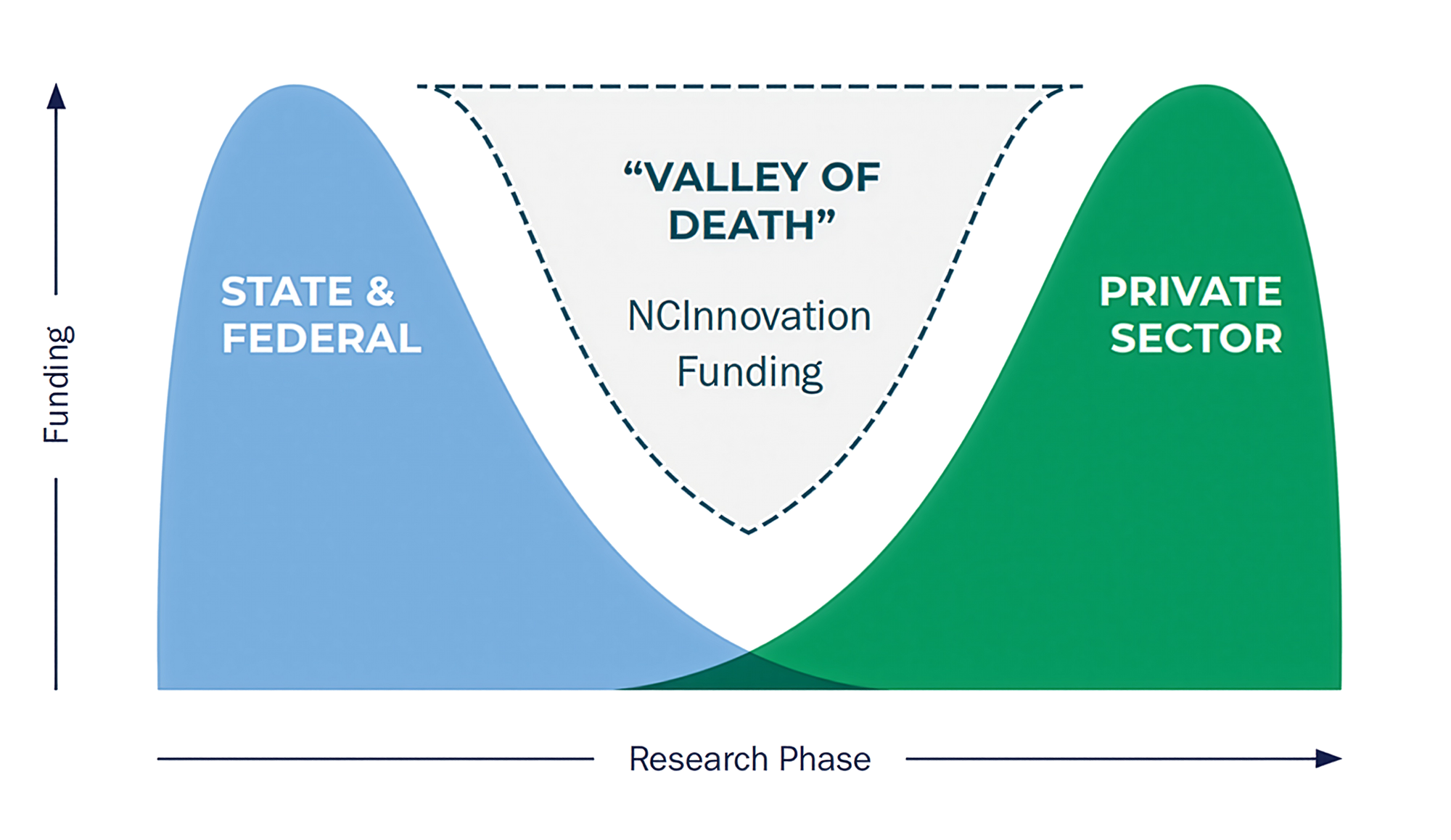 |
WHY DOES ANY OF THIS MATTER IN NORTH CAROLINA?