

At its core, NCI is a regional economic development initiative centered on our world-class university system. Specifically, the organization:
Provides grant funding for university applied researchers to mature a proof-of-concept to the point of commercial viability.
Supports the transition of applied research and new technologies from academia to industry with funding for comprehensive business development and other support services, coupled with ongoing coordination between universities and the private sector.
Identifies innovation opportunities in key industry sectors, helping guide university research and resource allocation to best position viable projects for commercialization.
Will forge a new path to unleash North Carolina’s innovation potential and support economic opportunity across all regions of the state.
NCInnovation’s programming and funding will drive lasting economic and technological growth across NC, ensuring that the UNC System universities remain national leaders in innovation.
PROGRAM DESCRIPTION
NCI offers grants to university researchers to advance their research breakthroughs to the point of commercial viability. To do this, NCI’s grants focus intensely on the middle phase of the R&D process – after proof of concept has been achieved, but before a technology is mature enough to attract private investment. Developing technologies to an inflection point, where a license for the intellectual property or a new startup company can be formed. Focusing on this phase maximizes the probability that a promising research initiative can be commercialized.
Government and private investors sometimes use a matrix called Technology Readiness Levels (TRL) (see table below, sourced from GAO) to define each phase of a research endeavor, from the very earliest idea generation (TRL 1) to end-stage market entry (TRL 9). NCI assesses research projects using this matrix to gauge their readiness for commercialization.
Technology Readiness Level (TRL)
| 1) Basic principles observed and reported |
| Lowest level of technology readiness. Scientific research begins to be translated into applied research and development. Examples include paper studies of a technology's basic properties. |
| 2) Technology concept and/or application formulated |
| Invention begins. Once basic principles are observed, practical applications can be invented. Applications are speculative, and there may be no proof or detailed analysis to support the assumptions. Examples are limited to analytic studies. |
| 3) Analytical and experimental critical function and/or characteristic proof of concept |
| Active research and development is initiated. This includes analytical studies and laboratory studies to physically validate the analytical predictions of separate elements of the technology. Examples include components that are not yet integrated or representative. |
| 4) Component and/or breadboard validation in laboratory environment |
| Basic technological components are integrated to establish that they will work together. This is relatively low fidelity compared with the eventual system. Examples include integration of ad hoc hardware in the laboratory. |
| 5) Component and/or breadboard validation in relevant environment |
| Fidelity of breadboard technology increases significantly. The basic technological components are integrated with reasonably realistic supporting elements so they can be tested in a simulated environment. Examples include high fidelity laboratory integration of components. |
| 6) System/subsystem model or prototype demonstration in a relevant environment |
| Representative model or prototype system, which is well beyond that of TRL 5, is tested in its relevant environment. Represents a major step up in a technology's demonstrated readiness. Examples include testing a prototype in a high-fidelity environment or in a simulated operational environment. |
| 7) System prototype demonstration in an operational environment |
| Prototype near or at planned operational system. Represents a major step up from TRL 6 by requirement demonstration of an actual system prototype in an operational environment (e.g., in an aircraft, a vehicle, or space). |
| 8) Actual system completed and qualified through test and demonstration |
| Technology has been proven to work in its final form and under expected conditions. In almost all cases, this TRL represents the end of true system development. Examples include developmental test and evaluation of the system in its intended weapon system to determine if it meets design specifications. |
| 9) Actual system proven through successful mission operations |
| Actual application of the technology in its final form and under mission conditions, such as those encountered in operational test and evaluation. Examples include using the system under operational mission conditions. |
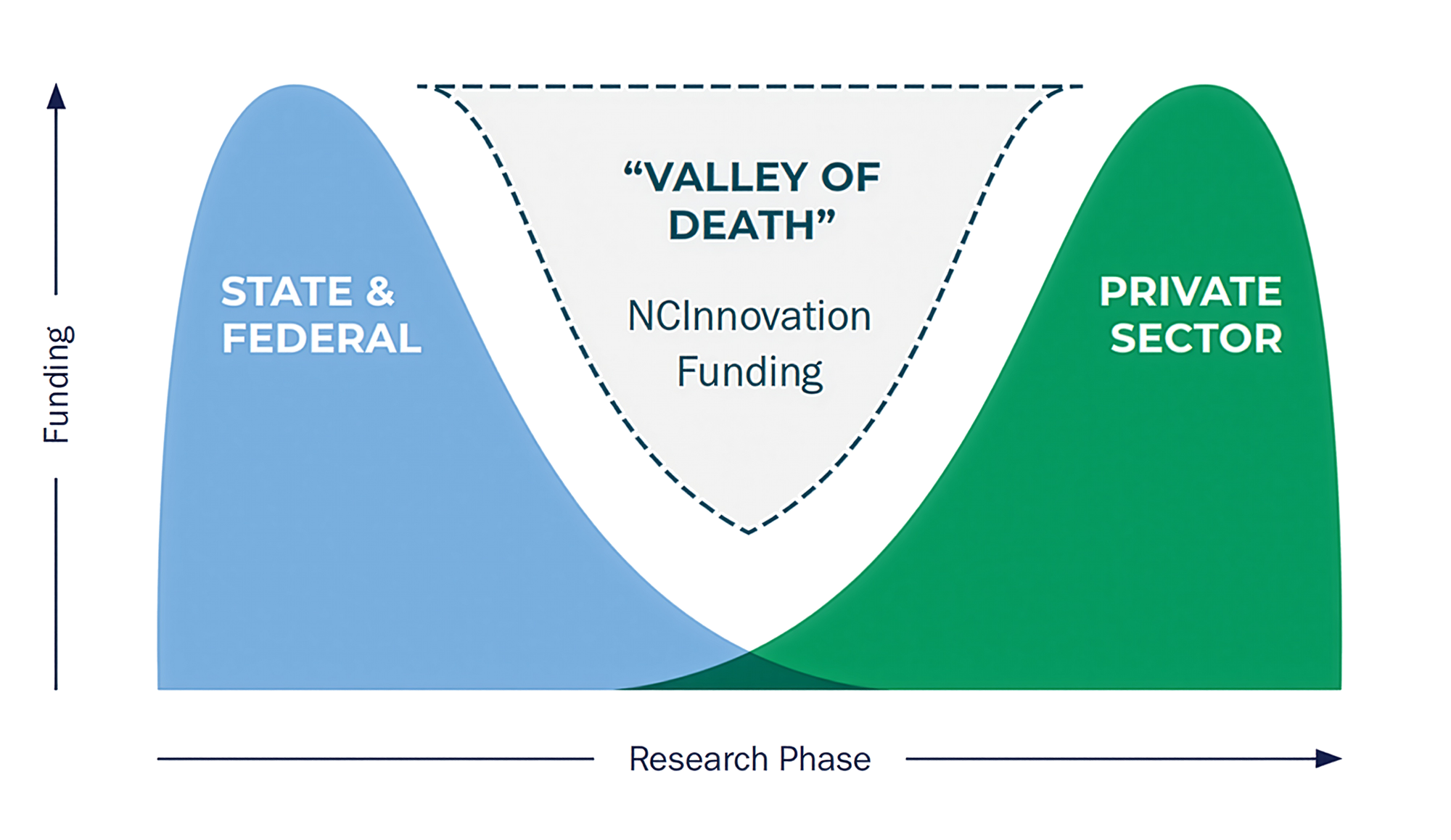
NCI focuses on the middle phase (TRLs 3-6), often referred to as the ‘valley of death.’ TRLs 3-6 are usually the most challenging and most expensive. It’s in this phase that researchers mature their technology, consistently testing and improving it so that it can work in more realistic settings. The description of this middle phase as the ‘valley of death’ captures the fact that without this funding, many promising innovations fail to reach commercialization. At this stage, there’s still much work to be done before a technology is commercially viable.
Those steps are expensive. Some universities may have resources for researchers working at TRL-3 or TRL-4, but funding to get through the valley of death is usually the hardest money to secure, especially outside mature innovation ecosystems like the Research Triangle. NCI focuses exhaustively on the valley of death, supporting North Carolina university researchers at the critical R&D stage, where the academic phase transitions from proof-of-concept to commercialization.